

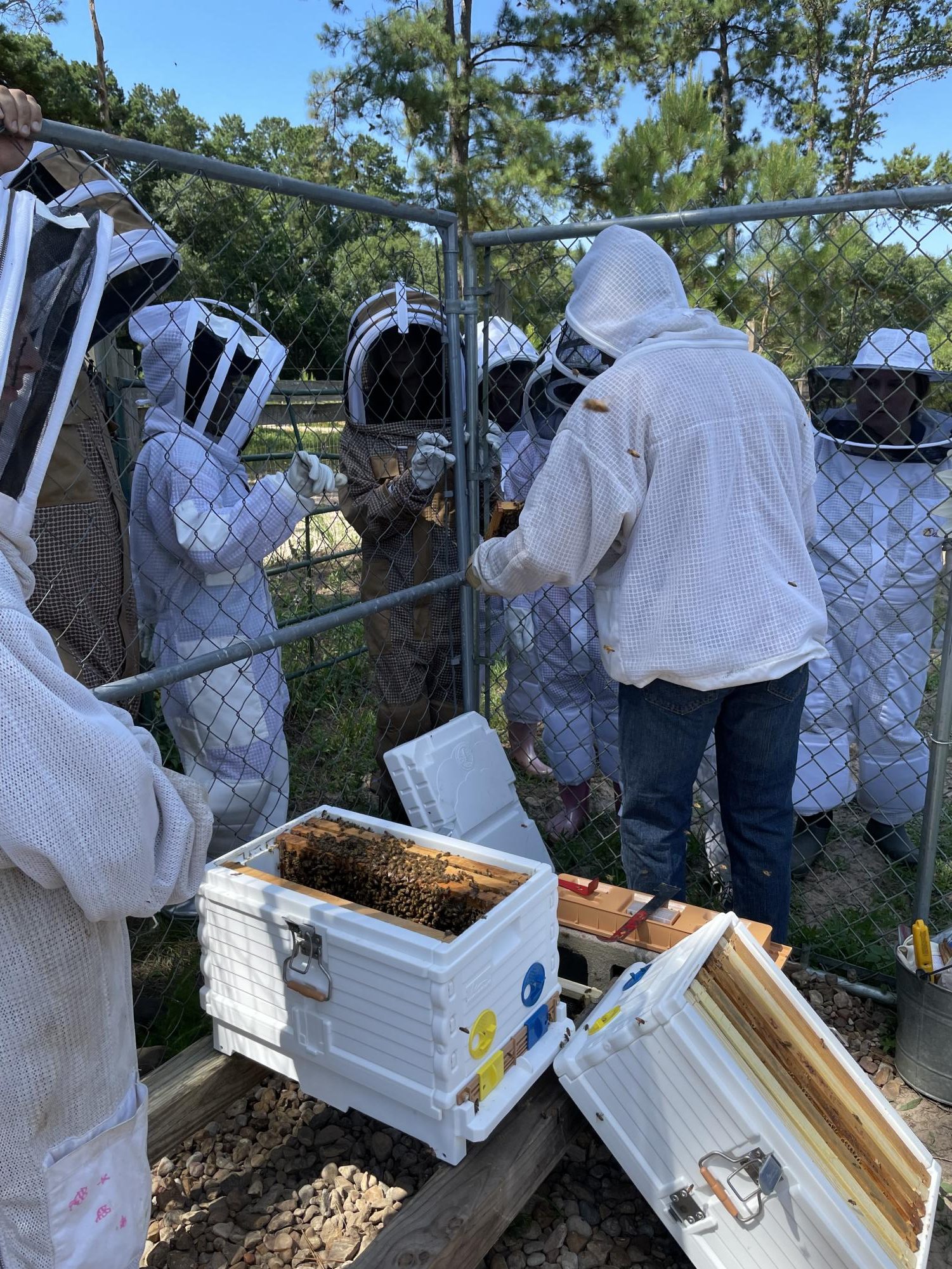
While most kids spend their weekends sleeping or partying, Bryce Maddux spends his tending to his six hives full of bees.
According to the National Library of Medicine, beekeeping has been around since 2450 BCE, where it was first developed in Egypt. Following its origin, the keeping of bees made landfall in the Mediterranean two millennia later, and traveled in Europe during the Middle Ages. From there, it spread around the world for generations, eventually ending up in the backyard of a modern-day high school student.
Maddux, a 17-year-old junior at the Woodlands High School, took up this unique hobby around five years ago: “When I got started, I was just looking around for something to do.” Little did he know, this activity would tide him over when everything shut down during COVID-19.
According to Maddux, beekeeping is the process of keeping and maintaining bees and their hives. To him, beekeeping is “like having a pet, except you’re just not around them as much.”
Unlike other hobbies, one can’t just go to any craft store to get the supplies to start beekeeping. To get started, Maddux found a local club–the Montgomery County Beekeepers–to teach him the basics. He has stated that they “taught him everything,” so when he got his first hive “as a package,” the club members would come to his house and help with the hive.
He bought his first hive online. “You can literally just order bees and they’ll mail it to you,” Maddux stated, “the mail person was not too happy.”
His second hive “was through the club,” as he was given a scholarship. Since then, Maddux has continued to collect hives, leading him to his current total of six hives.
With having bees comes the natural consequence of harvesting honey. According to Maddux, the best time to harvest is “in the middle of July when the flowers stop blooming or slow down.” At this point in the year, Maddux’s bees will have produced “a hundred pounds of honey.” With such a large amount of honey, Maddux will usually “give it away, sell it, [or] eat it.”
Despite what most people think, Maddux rarely gets stung, and when he does, he does not mind it. The amount of times he gets stung is directly related to what he is doing. “If I’m just going in there and looking at them, maybe once, maybe twice. If I’m actually messing with them–like one time I had to move a hive–, I don’t know how many times I’ve got stung. They don’t really hurt anymore,” Maddux stated.
Unlike a typical pet, bees don’t need around-the-clock care. According to Maddux, part of the reason he loves the hobby is that “it doesn’t take that much [time]. Normally it might take an hour out of my weekend, maybe two.”
Although Maddux is a successful beekeeper now, he had some struggles starting out. To him, “it’s not like having a dog, [where] you see the dog so you can tell something’s wrong and you’ll fix it.” In response to this struggle, Maddux has learned how to “take notes” because he has to “remember how many bees were in [the hive]” to make sure nothing is going wrong.
Though he struggles with some aspects of the hobby, Maddux finds great enjoyment in how “it all makes sense.” By this, he means that “if you do something, you’ll get everything back.” With this work, he sees his effort come to life once he sees the bees thriving and the honey harvested at the end of the year.
Maddux’s advice to anyone exploring the idea of having their own hives is that they must “make sure [they] want to do it.” When people “go in [the hive], they get a little scared.” He said that one “should still push through,” and that once they “push through that barrier, they’ll love it.”






JAMIE JAY MADDUX • Jan 19, 2026 at 9:30 am
A most excellent story. Do you jar and sell your honey? In the 70s, back on the farm, my adopted father kept 2 hives. He would smoke the bees out to get the honey. The bees always came back. The winters back then seemed colder then now. The tanks (small lakes) froze over. I had to bust the water tubs with a hammer so the horses and cows could drink. I now wonder about the bees?