
The History of Rowing
Rowing boats have been around for thousands of years, existing in many shapes and forms, wherever people and water mix- and the sportive nature of it just as long. An overview of the sport’s history on the World Rowing Federation’s official website dives into the events that would lead to the evolution of the sport into what we know it as today.
According to worldrowing.com, competitions between boatmen have existed for centuries: “The earliest regatta was held on 16 September 1274 in Venice, Italy, where regattas developed as challenges between gondoliers and boatmen in a variety of rowing boats”. Although rowing teams existed, the sport itself would truly blossom years later, according to the article: “The origin of the sport of rowing as we know it today comes from England, where the world-renowned Oxford versus Cambridge University Boat Race was first held in 1829 on the River Thames”.
This race between the two universities drew a crowd in the thousands, and its popularity would kick-start the world of competitive rowing. The surge in rowing’s popularity continued into the 19th century as the sport spread to the rest of the world. The increase in sports popularity led to an increase in clubs, and soon the need for a universal set of rules was apparent. This led to the creation of the World Rowing Federation, known initially as FISAA (Fédération Internationale des Sociétés Aviron).
Design and Anatomy of the Competitive Racing Shell
Rowing boats used by athletes are very different from the bulky wooden rowing boats most people are familiar with. Although competitive rowing boats were first fashioned from wood, modern boats are made from much sleeker materials such as carbon fiber or Kevlar. Boats are designed to be as thin and lightweight as possible to minimize the excess effort required for athletes. Inside the boat, the athlete puts their feet into a pair of specialized shoes attached to a wooden frame, called the footboard. Athletes sit on a seat with wheels, which is connected to a track.
Both the seat and footboard can be adjusted forwards or backwards in order to accommodate the athlete’s height. In front of, or in some cases behind the athlete is a metal, bow-shaped piece called the “rigger”, deriving its name from its adjustability. The rigger is fastened to the boat with bolts and can be moved/flipped to accommodate different rowing styles (this feature also allows for better accommodation on trailers during transport).
At the end of a rigger is an oarlock. The oarlock is a plastic, U-shaped device with a swinging metal piece at the top, called the gate, which can be tightened and loosened to put in/remove the oar. Like most boats, the bottom of a rowing boat has a fin (also known as a skeg). In some boats, a section of the fin is separate and can be adjusted to assist in turning, controlled by a mechanism of strings attached to one of the shoes on the footboard.
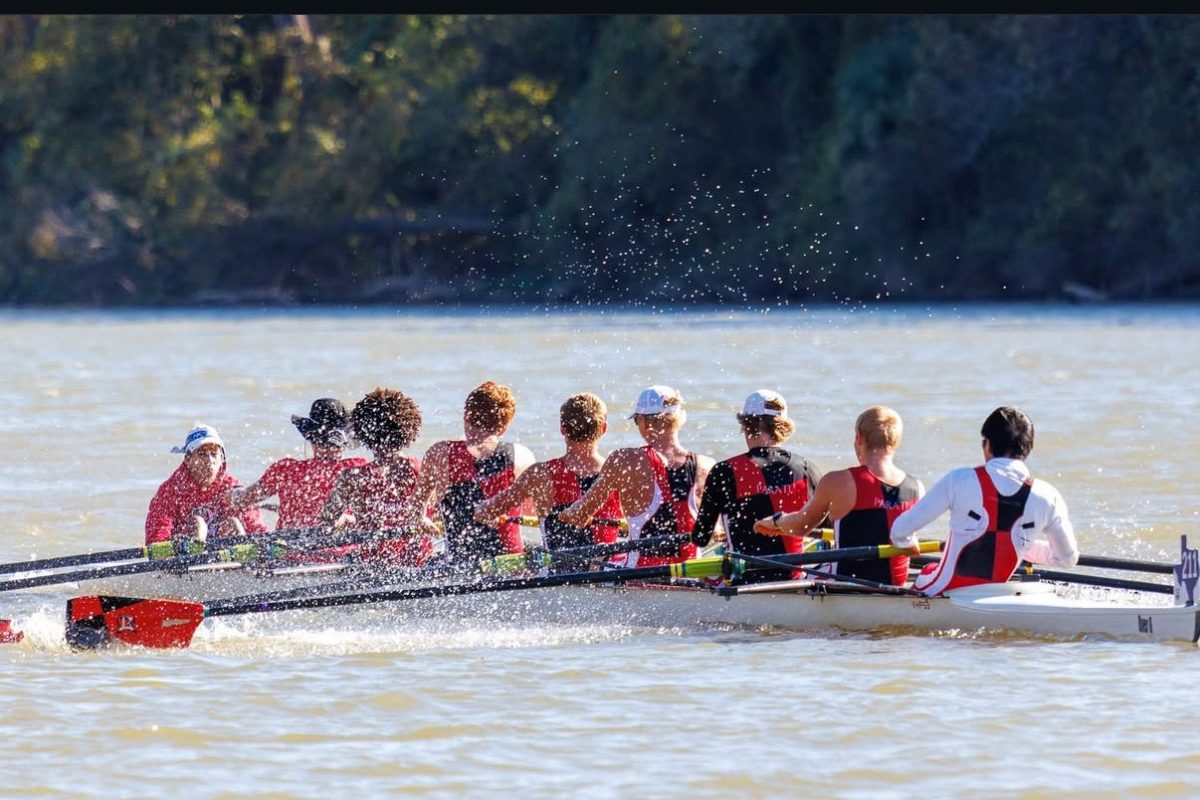
Although all boats have the same core features, boats vary in number of seats, ranging from one person to eight. These boats are known as singles, doubles, quads, and eights. There are two kinds of boats- “Sweeping” boats and “Sculling” boats. In sweeping, rowers use one large “sweeping” oar; whereas in sculling, rowers use two smaller “sculling” oars. For large sweeping boats like fours and eights, a coxswain sits at the back of the boat.
The Coxswain is an extra person in the boat who does not row, and instead steers the boat and provides commands and encouragement (sculling boats with coxswains exist as well, known as coxed quads- albeit not as popular).
The Two Phases of the Competitive Rowing Stroke: Drive and Recovery
The motion rowers take to propel the boat is known as the rowing stroke. A misconception is that rowing is done on a stationary seat and with the arms, like the traditional rowing boat. This is not the case. Arm strength plays a minimal role in rowing, with the majority of the power coming from the legs, and is followed through with back and core strength. The rowing stroke consists of two parts: The recovery and the drive.
In the recovery, the athlete makes their way up to the catch, or the point at which the rower will drop their oars into the water. The blades are “feathered”, or kept parallel to the water’s surface, and the rower extends their arms out fully, followed by leaning forward at the hips. Then, the rower begins up the slide and “squares” the blades, or rolls them perpendicular to the water’s surface. Once the blades are in the water, the drive begins in the following sequence: Without moving their back, rowers push with the legs while keeping their arms straight; once the legs are fully extended, the arms and back follow, and the blades are removed from the water at the very end of the drive (when the athlete bends their arms and the handles meet at the athlete’s sternum), feathering them once more.
Maintaining smooth sequence, posture, and horizontal arm motion are important to a clean and precise stroke: In rowing, every stroke matters.
Races and Regulation Categories in Competitive Rowing
Rowing is a sport similar to track, where athletes race against each other in courses varying in length. Like track, there are sprints and long distances, and these races are measured in meters. Rowing races are known as Regattas. Regattas are held in all bodies of water; while coastal competitions are held in coves or along the coastline, inland competitions are usually held in artificial lakes and rivers. More important regattas will have venues dedicated to hosting.
At regattas, multiple teams from different cities, states, and regions (each at the respective level of competition) come together to compete in multiple events. Events vary by interchanging 3 categories: gender, boat, and age/skill. In a race, only boats of the same category and kind are allowed to compete against each other. An example of an entry you might see is “Men’s U17 8+”, or a men’s sweeping boat with eight rowers under the age of 17.
Essential Training and Performance Technology
All sports involve some technology involved in measuring or recording of athlete performance. Rowers have used technology faithfully, allowing them to constantly view their own speed, stroke rate, distance traveled, and more. The machine that allows athletes to view all this information is known as a StrokeCoach.Rowers will almost always carry a trusty StrokeCoach with them in the boat. StrokeCoaches are gps devices that display a variety of information that you see on ERGs, or Ergometer. They derive their name from the Greek word ergon, which means to work. Ergometers look and function similarly to a seated cable row machine that can be found in most gyms: Instead of a rack of weights, though, the ergometer’s cable attaches to a fan that can be adjusted for resistance.
Attached to the part with the fan is a small digital monitor that displays all the information important to a rower. Additionally, rowers can choose to create their own “pieces” or workouts. Workouts can also be set to a set amount of time or distance, or interval pieces, which allows athletes to repeat an exercise with breaks in between.
Additionally have the option to select default exercises- ones that are common in rowing like 2ks, 5ks, and 30-minute pieces. Ergometers allow an extra layer of training during times when weather or location may make rowing unavailable/not possible, while still providing a simple way to practice the familiar motions of the sport.
Rowing clubs include all sorts of people who, despite their differences, can come together to train and improve on the one thing that they undoubtedly share- the discipline to face mentally and physically demanding practice. Despite the hardships, all rowers can agree that a boathouse is a hearty and friendly place that cultivates teamwork and motivation- like a second home. Rowing embodies the values that are found in many sports, while being equally unique. For a sport that can be found almost anywhere in the world, Competitive Rowing does not get as much recognition as it deserves.
If you or anyone you know is interested in becoming involved in rowing, the Woodlands/ Houston area has two competitive rowing teams at Woodforest Bank Boathouse, Northshore park: Rowing Club of the Woodlands and Parati Competitive Rowing. For more information on both, view the websites below.