
As I made my way through the entrance of Sam Houston State University Woodlands Center, the new building across from College Park High School, I found myself in the company of two older women. Some of the nicest, most welcoming women I’ve ever met.
“Are you one of the winners?” One of them asked after we had exchanged a few niceties.
I assured them that I was not one of the winners of the youth essay contest, but instead, there for my school’s newspaper.
Although I found it strange, flattering, but strange, that they would assume that I was a winner, it became less strange to me when I made it to the meeting room on the fourth floor: there were no other teenagers in the Montgomery County League of Women Voters.
According to current membership chair Audrey Bold, the League is a “volunteer, women-led, grass roots organization that believes that the freedom to vote is a non-partisan issue.”
And it was that same lack of youthful participation which inspired the event: their annual “Get Together” — this year’s theme was “We the People: The Power is in Our Hands.”
I got to the meeting a few minutes early, while League members and non-members — women and the occasional man — milled about the large conference room, many taking some of the plenty refreshments: lemonades, iced teas, cookies and the like. To celebrate “250 Years of HERstory,” two large screens projected scrolling images and quotes from important female politicians, activists, scientists etc.. At the same time, some attendees posed in front of a red, white and blue balloon set-up for pictures. The speakers played various politically conscious songs: “Get Up, Stand Up” by Bob Marley and “Teach Your Children” by Crosby, Stills, Nash, & Young.
After a mic check, the slight buzz that filled the room turned into a mostly silent audience: ignoring the occasional chatter amongst tables of women and the sound of catered bento boxes being opened.
The meeting started with a debrief. Bold gave thanks to all of us for our presence: this was some of the best attendance yet. Then came a quick disclaimer.
“The League of Women voters never supports or opposes candidates for the office or political parties,” Bold said. “Any use of the League of Women voters name in campaign advertising or literature has not been authorized by the League.”
The Montgomery County chapter is part of a wider League that has chapters all over the nation. Established in 1920 to help educate women on election processes and to advocate for legislation protecting women’s rights, the goal has long stayed the same.
She then recommended we look at the voter guides, which sat on every table in the room: all of which were decorated with a white cotton tablecloth; red and blue place mats, each with a small box on top wrapped with a patriotic ribbon; a card detailing the event’s itinerary; another card with a QR code to donate to the organization; and a bracelet, every one unique, beaded in some combination of red, white, and blue.
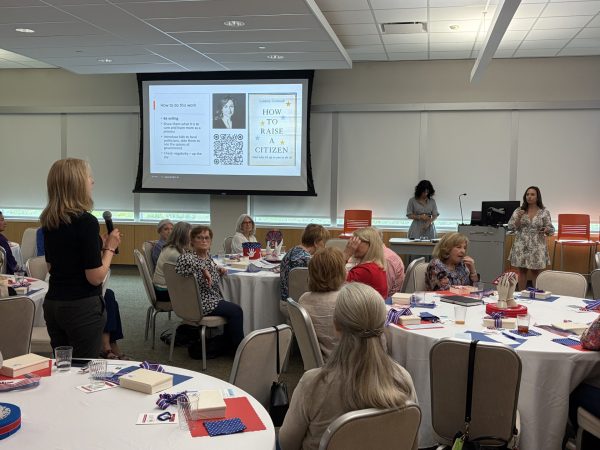
It was evident that, as Bold said, the meeting required “a tremendous amount of planning,” planning that apparently spanned months.
So, I picked up the voter’s guide, a thick white packet printed in black ink, and flipped through. The pages were filled with politicians advocating for themselves; the League asks all candidates in contested races to submit a response to short questions.
“When you leave here today, you’ll have no doubts about where to go to get trustworthy, unbiased and accurate information,” Bold said.
Perhaps more important, the League offers a place for people to organize and participate in democracy.
“Each of us plays a role in shaping the future of democracy; whether through voting or volunteering, or the conversations we all have at home, each of us holds more influence than we carry alone,” Bold said.
Bold then introduced the three essay winners, two of whom walked over to a trio of orange high chairs. The top two winning students read their essays, and a teacher read the third place winner’s, who could not attend because she was busy accepting another scholarship.
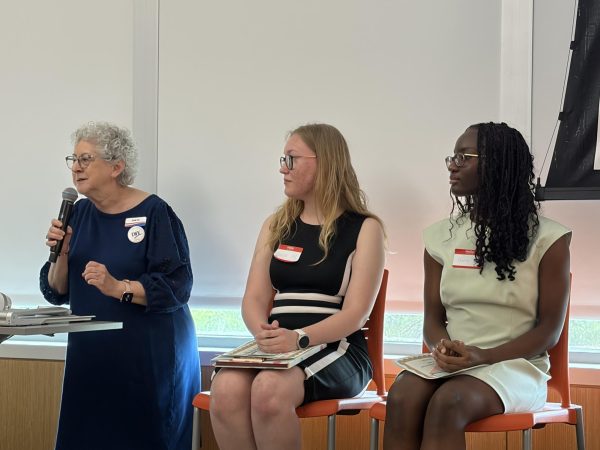
The League received 16 entries from six different high schools in the area: Grand Oaks, Splendora, Caney Creek, College Park, Oak Ridge and The Woodlands.
But all three students came from Grand Oaks. The first-place winner Emilia Matuszyk read her essay first. It marked the start of a nearly three-hour long discussion focused on the importance of youth participation in the government.
“In times like these, when there is unlimited access to various resources, we, the youth of the nation, take the first step in creating the changes we want to see in our futures, no matter how small.” Matuszyk said, the end of her essay.
After Matuszyk, the second-place winner and their teacher read the essays, they were each awarded a cheque. Matuszyk received $500, and teacher Ms. Anderson received $100 for her exemplary work; she taught both the second and third place winners.
This was the first time they’ve had an essay contest. The essays were judged by a panel of three: Teresa Kenney, owner and founder of local bookstore Village Books and leader of non-profit organization “Reading is Revolutionary” which provides books to kids who otherwise would not have the access; Datron Adams, who served on the school board for over a decade; and Miranda Ramirez, an adjunct professor for the English department at Lone Star College.
“We had a great group of judges, as you can tell,” current Montgomery County League president Deb Salzburg said.
After Salzburg gave her acknowledgements, guest speaker Lindsey Cormack stood to discuss her semi-new book “How to Raise a Citizen (And Why It’s Up to You to Do It).” Cormack also is an associate professor of Political Science and the Director of the Diplomacy Lab at Stevens Institute of Technology in Hoboken, New Jersey.
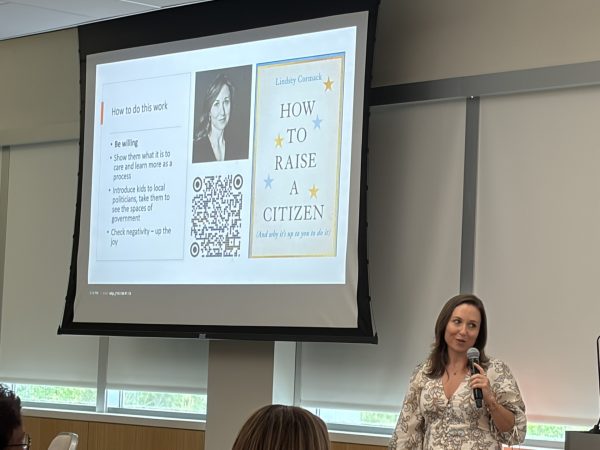
She was proud to announce the recognition politicians — from both parties– gave her book. She mentioned how she appeared on C-SPAN to discuss the book and how current governor of New York Kathy Hochul called her book “the most important book that was written this year [2024].”
“But before you get afraid: like, who’s this lady from New York and that liberal governor who said something about it, I’ll have you know that President [George W.] Bush, and former First Lady [Laura] Bush, also wrote about the book, saying that it was doing good work,” Cormack said, with a slideshow visual-aid behind her showing a photograph of a signed letter from Laura Bush.
In short, the thesis of Cormack’s book is this: although civics education in schools — and competent teachers teaching it–is important for teaching youth how to meaningfully participate in government, it is also equally important for parents to teach their children the basics.
Before one learns about parties, one must first learn about the political system itself.
To Cormack, it is equally important that parents or guardians teach their children civics just as much as it is for students to receive sufficient civics education in school. She uses an analogy to describe the importance of teaching the political system to children.
“Let’s say you wanted to raise an athlete, a child who really wanted to play soccer,” Cormack said. “If you wanted to raise them to be the best soccer player they could be, you would say, okay, let’s watch some games. Let’s learn some drills. Let’s maybe do some scrimmages. We’ll condition off the field, and you’re going to be really good at doing this game, so that when they’re grown up, and they’re getting drafted to whatever team, they’re gonna be as good and capable as an athlete as they can be.”
“If you are just trying to raise a partisan, it’s more like raising a spectator or a fan,” Cormack said. “You’d say, here’s the colors you paint your face. We boo when this person gets on the field, we do this weird dance, and we cheer when someone else is here.
“But in politics, we’re really all athletes,” Cormack said. “None of us are spectators, even if we’re sitting it out, you’re just a less capable athlete, and you might not know which team you’re hurting or helping. And so we should give our kids the tools and the agency to be as best capable athletes as they can in politics, and let them figure out the party part later.”
Cormack recommends the young, once they’ve learned the basics, to participate in local government in whatever ways they can. Furthermore, she urges parents to show enthusiasm themselves.
“They need us to show curiosity and engage with things when they’re difficult,” Cormack said. “I also think it’s important that we take them when we’re doing things. If you’re going to a city council meeting, it will be boring. But it is good for them to see that, and it is very good for the council members to remember that our constituents are not just this 40-and-up crowd.”
She says that politics can also serve as an antidote to the common ills of our society, especially our youth: depression, anxiety about the future, loneliness.
“And I tell them, if you can find something in the political, broadly defined field that allows you to do purposeful, repeated, in-person interactions with people, like joining a league or doing a mutual aid, taking part in cleanup, you can really overcome some of these very hard things,” Cormack said. “And the more you know about our system, the more you know about our government, the less scary doom scrolling can be at night because you understand where the limits are and you see your own power in it.”