

You hear the chime of a piano. It flutters in circles around you. It bewitches you. You do not know where this tune plans to lead you, but you know you will blindly follow it no matter where it goes.
You are now entranced, but then there’s suddenly a change in tune that startles you. Now that the piano has flown a few circles around you, it slows to a lulling drawl.
You hear a voice. It’s an old voice: that you can tell by the record’s crackle. But there’s something else about that voice: something else about it that would sound old even if it were recorded on the newest, most advanced technology. It’s as raspy as it is smooth, as melancholic as it is saccharine. It’s the voice of a woman who is as disillusioned as she is romantic.
It is the voice of Billie Holiday. She’s singing “These Foolish Things,” one of my favorite songs of the 1930s: a song that is as steeped in sentiment as a sachet is in a cup of black tea.
Throughout the song, Holiday waxes poetic about the “foolish things” that remind her of a lost love. In the first verse, it’s “a cigarette that bears a lipstick’s traces” and “an airline ticket to romantic places.” Later, it’s “a tinkling piano in the next apartment” and “a fairground’s painted swings.”
These images are so innocuous, so mundane. The cigarette and the ticket are buried in a dumpster somewhere. The piano is a nuisance — your neighbor won’t stop playing even in the dead of night. And as you pass by those swings every day on your way to work, you see that their red paint is now flaking.
Yes, these images mean nothing by themselves, but when they are strung together in a melody with Holiday crooning them, they sketch the outlines of a great romance. Not necessarily a romance in the sense of a love affair, as in “These Foolish Things,” but perhaps just the type of romance — a feeling of transcendental awe — that Thoreau felt while looking over Walden Pond.
This is the power of association: the power to attach a romantic meaning onto images or objects simply because they connect to another memory of yours.
It is easy to ignore these associations when you are not paying attention. It is easy to forget about the time when you were a child and rushed to catch fireflies when they now buzz past you on an evening walk. It is easy to forget about how your late grandfather read you some children’s book before bed when you now walk by a display with the same book at Barnes and Noble.
You can keep these objects: put the book on your bookshelf, or even the fly in a mason jar beside it. By doing so, you capture a moment in time. You are able to preserve the ephemeral — the emotions that flit through your life at high speeds — the emotions that often only reach you for a short second and leave you in a stupor.
Oftentimes, you throw away the things that hold the most emotional resonance — this is a tragedy. When you finished your first ever cigarette, you threw out your matchbook. When you went to your first concert, you threw away your ticket stub. When you finished your first perfume, you threw away the bottle.
When you throw these items away, not only do you lose tangible evidence of your memories, wonderful catalysts for self reflection, you often lose historical artifacts of great cultural and artistic significance.
This winter break I visited The National WWII Museum in New Orleans. It is a massive museum that chronicles American participation in WWII in intricate detail.
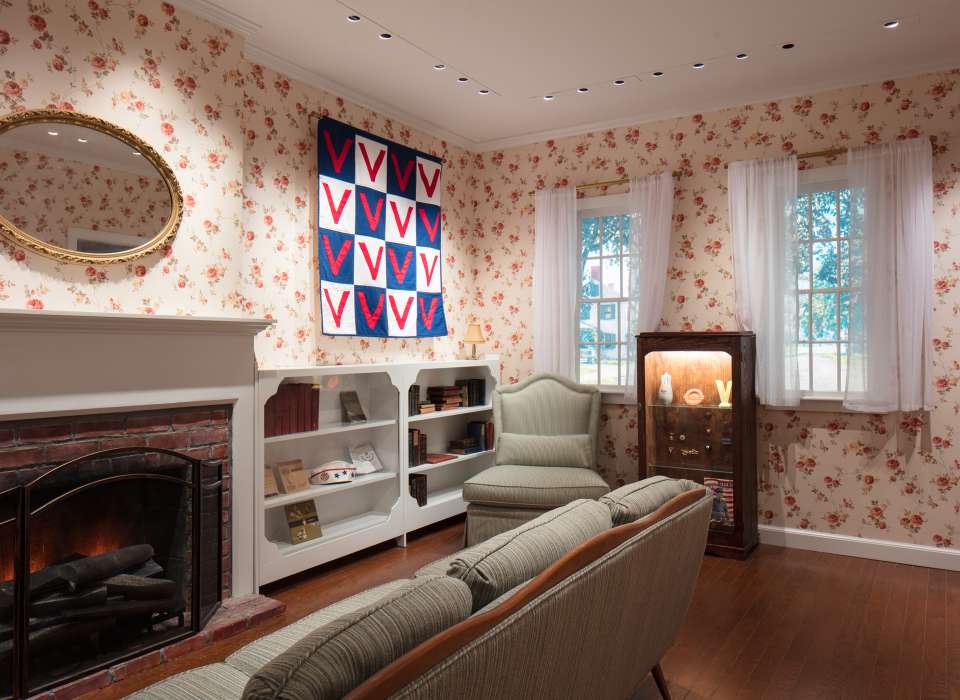
I only visited for a couple of hours, but in my relatively short stay I was able to find an exhibit that resonated with me deeply. Within the museum’s so-called ‘Arsenal of Democracy,’ were galleries featuring artifacts produced and used on the American homefront during the war. There was an especially quaint exhibit that reproduced a period accurate living room, featuring a portrait of FDR and genuine letters home from soldiers.
In another room lay propaganda produced for the homefront after America entered the war. In another there were various recreations of soldiers’ living spaces. There is a wealth of artfully designed ephemera in these collections, but amongst my favorites were the many items emblazoned with a large “V” for Victory, as well as several vintage pinups, some featuring Hollywood icons like Betty Grable and others rendered by artists like George Petty.
These objects are lucky to have survived. Although they were once one of many copies of a consumer product or flyer, they now are one of a small few.
They were all likely at some point owned by a regular person like you or me. They often were excessively meaningful to the people who had them, or in other cases so incredibly banal and commonplace as to warrant no upkeep. In the case of the latter, they were often thrown away immediately, and for the people who cherished them, they passed eventually — leaving these items to the whims of whoever inherited them: possibly thrown away, or possibly sold at an estate sale — although many times it is the former.
Unlike more official forms of art, the art contained in consumer products, advertisements, or any other easily reproducible paper item, often is thrown away in a short time. These pieces are called ephemera.
In William Harmon’s “Handbook to Literature,” a book used as the guideline for Texas’s literary UIL competitions, ephemera is sometimes described as being of “aesthetic interest as specimens of craft and taste, even if they have no philosophical importance.”
I disagree. Any piece of ephemera, no matter how banal or kitschy, contains at least an inkling of philosophical importance. The very fact that they represent the life lived by someone long ago is important. The fact that, although many of these people do not remain, some of their possessions do, is important. Every piece of paper has a story.
As proven by the popularity of pop artists like Andy Warhol, urbane, political, and commercial art can be just as deserving of official aesthetic and philosophical appreciation and speculation as more traditional forms of art. In fact, because popular art and ephemera is representative of the general populace’s media diet, it is oftentimes more representative of the human condition than anything else.



Hailey Carimichael • Feb 6, 2026 at 12:44 pm
wow. this is a beauty