
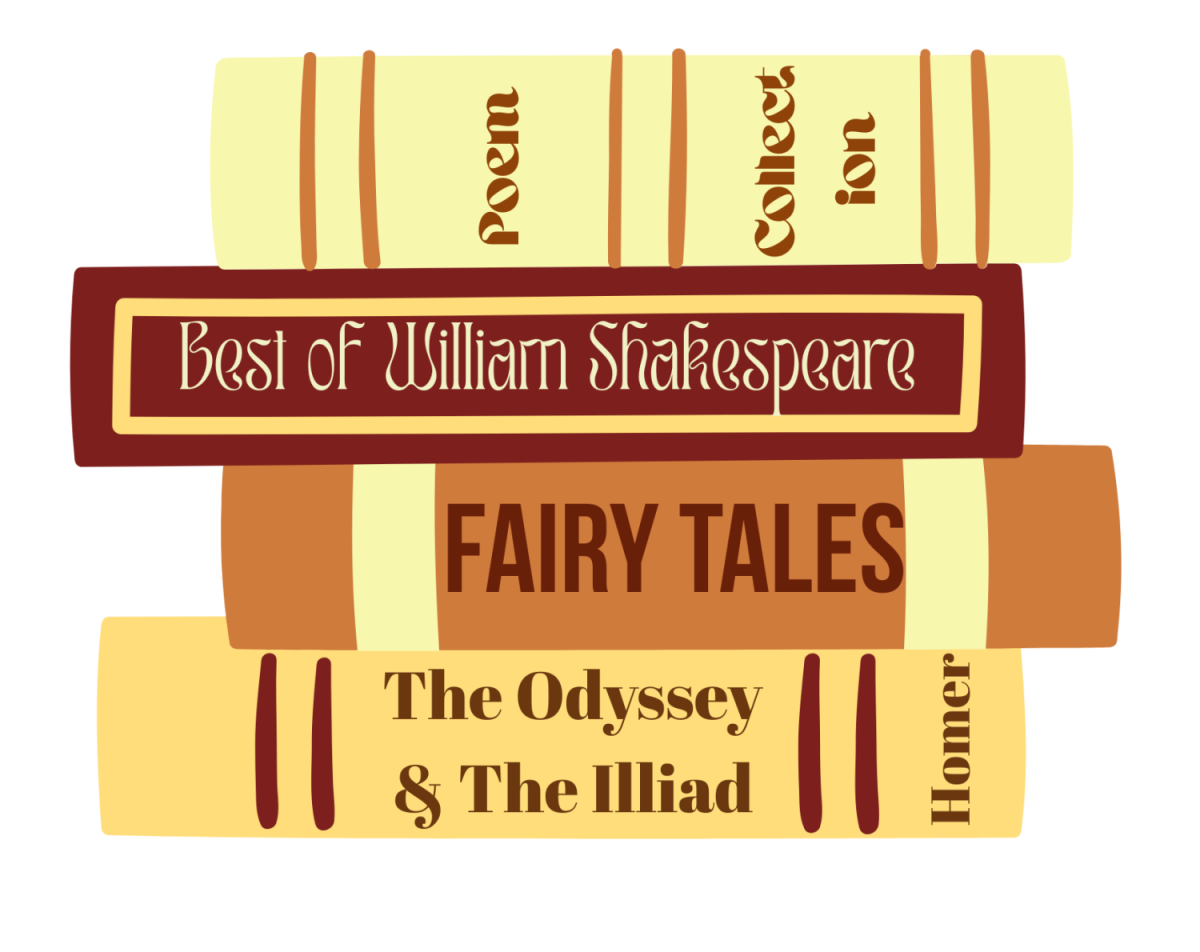
In November, the Texas Education Agency (TEA) proposed a mandatory reading list, requested by the state in 2023 and which you can find here, that would go into effect in the 2030-2031 school year. The list of almost 300 considered books contains a list of 15-20 books per year for elementary schoolers and “units,” for sixth to twelfth graders, with a central “anchor” text, then other works that give background or real-world applications to that text, creating a rigorous course plan. Most notably, this list includes a lack of diversity on many different scales, causing issues with many who look for these things in their children’s education. On January 28, the board decided to postpone their decision until April to allow members extra time to consider the works on the list and their decision on the matter.
The board should decline this list for a multitude of reasons.
The first point is that the list is incredibly long. It’s true that the five anchor texts per year may not be that much, but students would also have to read the accompanying works, usually 3 to 4 for each anchor text. Though these would be shorter than the anchor texts, they would add up, giving students and teachers less time to teach the main book. This is especially shocking when one looks at a survey conducted by Franklin Strong that reveals that the average amount of books (with a few smaller works like poems not counted and often including a summer reading or free choice book) that high school teachers assign each year is 6.2. This list is a drastic difference from that, and will probably rush the students to read and overall impact their learning, while also forcing the teachers to create extra assignments and tests.
Next comes a lack of inclusion and diversity: one of the biggest of these is that Bible texts are featured on the list, which could do little good for the school unless revised. This could push ideas on young children, as these passages begin to be included in 6th grade, with Bible-based stories starting immediately in kindergarten. It is not entirely wrong to include these texts, as some of the stories, such as the Golden Rule, are excellent learning opportunities for children. However, similar stories could likely be found in works from other religions, and by only representing Christianity on their list, it seems that TEA wants to show that it is the superior religion or the only one that matters. This imbalance could impact children’s perception of the world, possibly pushing ideas on young minds. The key here is inclusion – the representation of all religions and the stories they can tell, not just one.
Another way inclusion is lost in the current list is the lack of diversity behind and represented in the texts. Very few texts are written by or predominately feature women or people of color. And though many older texts were authored by or focus on white men because society wouldn’t allow the voices of others to be published and heard, by not including more modern texts by these people, schools are essentially doing the same thing. As a quote from Aziel Quezada, a college junior, in a U.S. News article asks, “where do [minority students] see themselves in these works?” Representation is critical to students, allowing them to connect to the texts and understand them deeper, and sacrificing a few older works for more modern ones that today’s students can relate to and interpret easier would most definitely be worth it in the long run.
Another example of this lack of diversity and limited worldview can be seen in just that – the list’s view of the world. Though there are a few texts covering historical events around the world, the focus is mostly on the Holocaust and a few ancient civilizations, with very little else. However, under almost every anchor text is a work relating to or about America – speeches from Abraham Lincoln or Teddy Roosevelt, informational texts (starting in kindergarten) about the cherry tree myth, White House, or other American symbols, and even the Federalist Papers. Meanwhile, the first story about a foreign historical figure or event, long past those of Paul Revere and Clara Barton, starts in 3rd grade, with Archimedes, nonfiction about ancient Rome, and a book about Egyptian hieroglyphics. While America represents important ideas of independence and freedom and democracy, and it’s critical for kids to be able to connect what they’re reading to the world they live in, that world isn’t just America and a few historical events or figures from elsewhere. Also, kids already get two years of U.S. history under the Texas education system, and English class doesn’t need to serve as another year of that.
Now, there are positives to the idea of this book list. Its uniformity and mandated nature would allow kids who switch districts or schools to be on the same page without skipping or repeating books. Despite this, it can be important for individual districts or schools to choose what they want students to read, so if they don’t like the religious or less diverse texts, they can’t remove them. The units are also a good idea, giving context to the anchor text and allowing students to make connections; however, they don’t always make sense. The list has plenty of strengths in structure and idea, but it loses those among its restricting mandatedness and sometimes confusing nature.
Frankly, the reading list isn’t a bad idea. However, the way it’s executed leads to so many flaws that in its current form, the list is not worth approving. That being said, if the board were to decline this list and revise it, adding diversity and inclusion in the cases of religion, authors, and subjects, and perhaps shortening some of the units, the reading list might be beneficial. Therefore, the board should decline the list and revise it.