
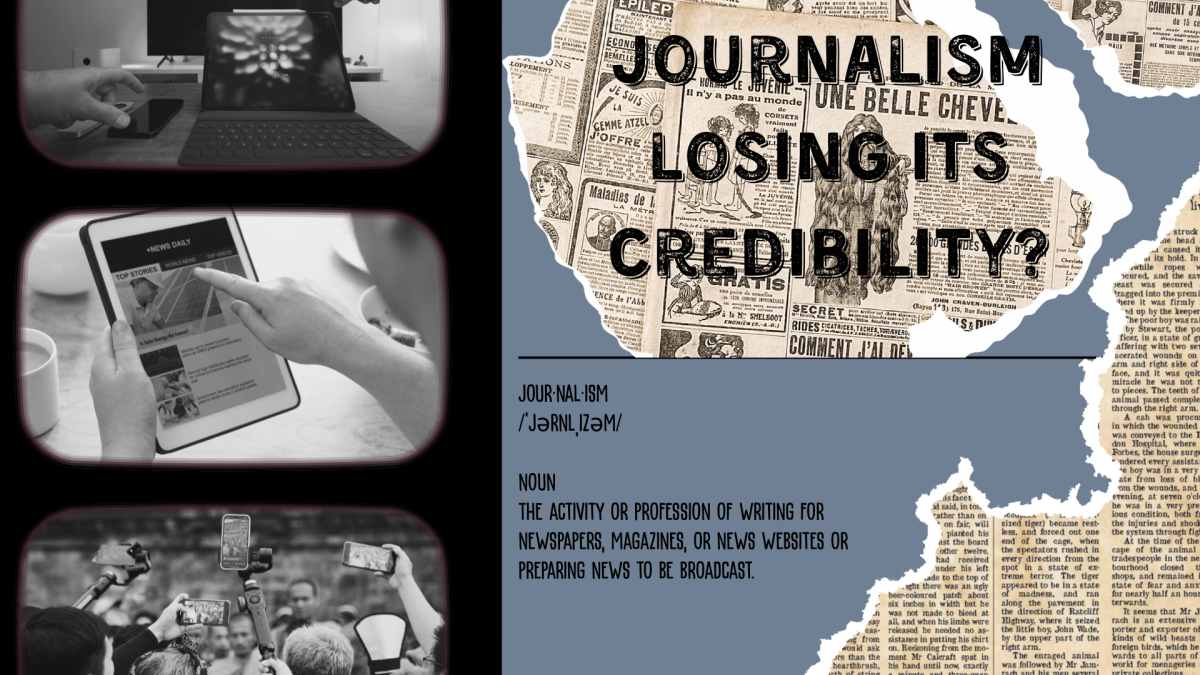
Fake news is a serious issue faced frequently on all forms of media: the news, social media, and, more recently, journalist articles. Journalists take pride in covering topics of growing interest and importance, bringing attention and circulation to important ideas and topics; so when the risk of circulating misinformation or disinformation comes to be a concern, it is evident that journalists need to make an effort to spot and regulate fake news.
The University of Michigan Library defines fake news as “news that is completely made up.” News has existed for a long time and, by consequence, so has fake news. Today, it has evolved to be much more diverse and complex than simply “made up.” For example, fake news is a term coined in politics to discredit claims of a competitor. On social media, fabricated or altered media is effortlessly made and is spread. The term “fake news” itself is not broad enough to accurately describe the different challenges faced across different forms of media.
Fake news mainly concerns misinformation and disinformation; the former refers to the unintentional spread of false or altered information, the latter refers to the purposeful spread and creation of false information to discredit or sway public opinion in favor of an indented subject. Both are problematic for journalists; on one side, the problem of disinformation poses the idea of spreading fake, exaggerated, or fabricated information in order to gain publicity (infamously known as yellow journalism). On the other side, there is the unintentional spread of false or out-of-context information, misinformation, something that particularly applies to inexperienced journalists; this is especially true when considering the emergence and rapid growth/utilization of AI.
Although misinformation and disinformation are their own separate problems, and are deserving of individual attention, the underlying cause for both is a laziness when it comes to referencing, crediting, or sourcing credible sources/information. This problem can be observed in social media, where fake news is spread the fastest. Viewers absorb misinformation, which almost always has no source or credibility, and are too lazy to fact check. From there, other content creators make their own posts and contribute to the circulation of false information. This is not unlike the spread of misinformation in Journalism.
With these ongoing threats, it is especially important to source and credit reliable information. This can include using academic resources, reputable media, and informative websites. When sourcing from other articles, it is important to funnel through respective sources to ensure legitimacy.
Fake news isn’t always as simple as being completely fake. Often enough, articles, videos, and news programs can have sprinkles of fake or fabricated information. They can serve to harm, gain traction, or persuade masses. Intentional or not, fake news is a challenge to the professionality of journalism, and must be regulated with ascertainment.
Bibliography
Desai, Shevon, and Jo Angela Oehrli. “Research Guides: “Fake News,” Lies and Propaganda: How to Sort Fact from Fiction: What Is “Fake News”?” Umich.edu, University of Michigan, 6 June 2023, guides.lib.umich.edu/fakenews.