

Woodlands High School students will pick the art that hangs in the school’s hallways for the fifteenth consecutive year.
From November 11-13, students will vote for their favorite art piece from a selection of thirteen created by local artists. During lunch and advisory this Thursday, students will be able to vote via paper ballot and through their Conroe ISD SSO account.
This opportunity is brought to the high school by the non-profit organization The Woodlands High School Art Trust (TWHSAT). TWHSAT, created in 2011, provides the school with a student-selected and student-purchased art acquisition program.
According to the TWHSAT’s website, TWHSAT’s mission is “to promote the development of creativity for every student through active involvement in the arts.”
TWHS Student Council raises the funds TWHSAT’s collection with money raised at the Homecoming dance.
According to TWHSAT, TWHSAT assists students in selecting works to be considered for the final group of pieces that the entire student body will vote on.
There are currently 71 pieces by 59 different artists in TWHSAT’s collection. The winning pieces this year will be added to TWHSAT’s permanent collection.
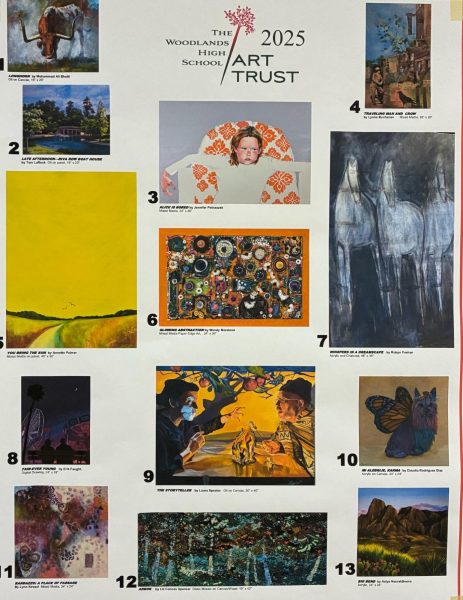
Many of this year’s nominations are inspired by their creator’s personal experiences.
Lynn Kessel’s piece, “Randazzo: A Place of Passage” explores Kessel’s journey.
According to Kessel, who typically paints impressionistic paintings, “Randazzo” was created as an exploration of the experience of going through a “passage”, whether that be a change in career or a move from one home to another. The creation of “Randazzo” was inspired by Kessel’s movement from one career to another.
“Even at my old age, I still go through passages,” Kessel said.
Although everyone has his or her own unique passage, the experience of going through some type of passage is universal.
Annette Palmer was also enlightened by an experience of hers. The inspiration for Palmer’s piece, “You Bring the Sun”, comes from Palmer’s recent visit to her home country of Scotland. The composition of the piece is based on a composite of her memories of the Scottish countryside, rather than a specific location.
However, the sky’s emphatic yellows are based on a particularly sunny day – an anomaly in overcast Scotland. Under the unobstructed light of the sun, a field of canola flowers became an artistic inspiration for Palmer.
Jennifer Polnaszeck’s piece, although not inspired by a specific experience of hers, also conveys emotion. Polnaszeck is interested in the human form and experience. She expresses the mannerisms and emotions of her subjects with her attention to detail, as can be seen in the subject’s facial expression and posture in “Alice is Bored.”
“My primary focus is the human form, the outward expression of attitude and emotion, that magic thread that connects us to one another,” Polnaszeck said.
Claudia Rodriquez Diaz reflects on her heritage in her piece, “Mi Alebrije, Karma”, as she references Mexican folklore to memorialize her Yorkshire Terrier, Karma.
“Alebrijes are fantastical creatures -brightly painted guardians that embody resilience and imagination … I gave [Karma] Monarch wings and painted her in radiant, surreal colors to capture both her spirit and the symbolic weight of transformation, freedom and loyalty,” said Diaz.
“Mi Alebrije” tackles loss and the possibility of afterlife. Karma’s butterfly wings recall angelic imagery whilst also representing death as a continuation of life. The butterfly wings represent Karma’s transcendence from one stage of her life to the next, as a caterpillar transforms into a butterfly.
For artist Liz Conces Spencer, who is both a working artist and teacher, art is meant to be created deliberately, not quickly. To her, art should represent the artist’s unique vision, rather than a photo-realistic depiction of the world around her.
“Art is not about replicating what you physically see with your eyes but how much of your soul you can incorporate into your vision,” Spencer said.
The display of art hanging in the hallways are not only aesthetically pleasing to the eye, they also can inspire creativity in young artists.
Wendy Moreland, who learned her paper edge technique from Youtube, uses art as a means of meditation. The process of creating the designs seen in her piece is both time consuming and therapeutic.
Moreland urges students to find a passion in which they can pour their emotions into.
“You want to do something positive. You can benefit from it, and other people can benefit from it too,” Moreland said.
Each artist’s reason for creating art is different. Whether the purpose be to memorialize, reminisce or inspire, what the artist seeks to do with his or her work affects its meaning. One piece’s meaning may resonate with one student, while another student may resonate with the meaning of a different piece.
Art’s inherent subjectivity lends itself to differing interpretations; it has the power to reveal its viewer’s sensibilities by evoking different emotions depending on the viewer’s own experience.
By voting for their favorite piece, not only do students select the piece of art that resonates with them, they also find common ground amongst their peers. The pieces that are selected are representative of the tastes and experiences of both the artists that created them and the students that selected them.